Why We Built NUDGE: The Architecture of Executive Intelligence
NUDGE did not start as a product roadmap. It started as frustration.
Not with data. Not with analytics. But with the experience of watching capable leadership teams sit in rooms full of dashboards and still struggle to answer one simple question: “What actually matters right now?”
Over years of working with executive teams across growth, transformation, delivery, and strategy mandates, we kept encountering the same structural pattern. Every function had optimized its own intelligence stack.
Sales had CRM systems tracking pipeline velocity and win rates. Finance had BI platforms modelling margins and forecasts. HR had people analytics measuring attrition and productivity. Delivery had trackers monitoring utilization and project health. Strategy had decks synthesizing market shifts. Competitive intelligence lived in PDFs. External signals lived in inboxes.
Each system worked. Together, they didn’t.
The Executive Stitching Problem
At the functional level, reporting was strong. Teams could explain their numbers. Variances were defensible. Metrics were visible.
But at the executive level, something else was happening.
The CEO was not asking, “How is CRM performing?” The CEO was asking, “Where are we exposed?”
A business head was not asking, “Is utilization at 82% or 84%?” They were asking, “Which delivery strain could impact our top three accounts?”
The board was not asking for more dashboards. They were asking, “What external shifts change our risk profile over the next two quarters?”
To answer those questions, leaders had to manually stitch context across systems. They had to connect:
- A competitor’s acquisition
- A slowing pipeline in a specific segment
- Attrition in a critical skill cluster
- Delivery strain on a marquee account
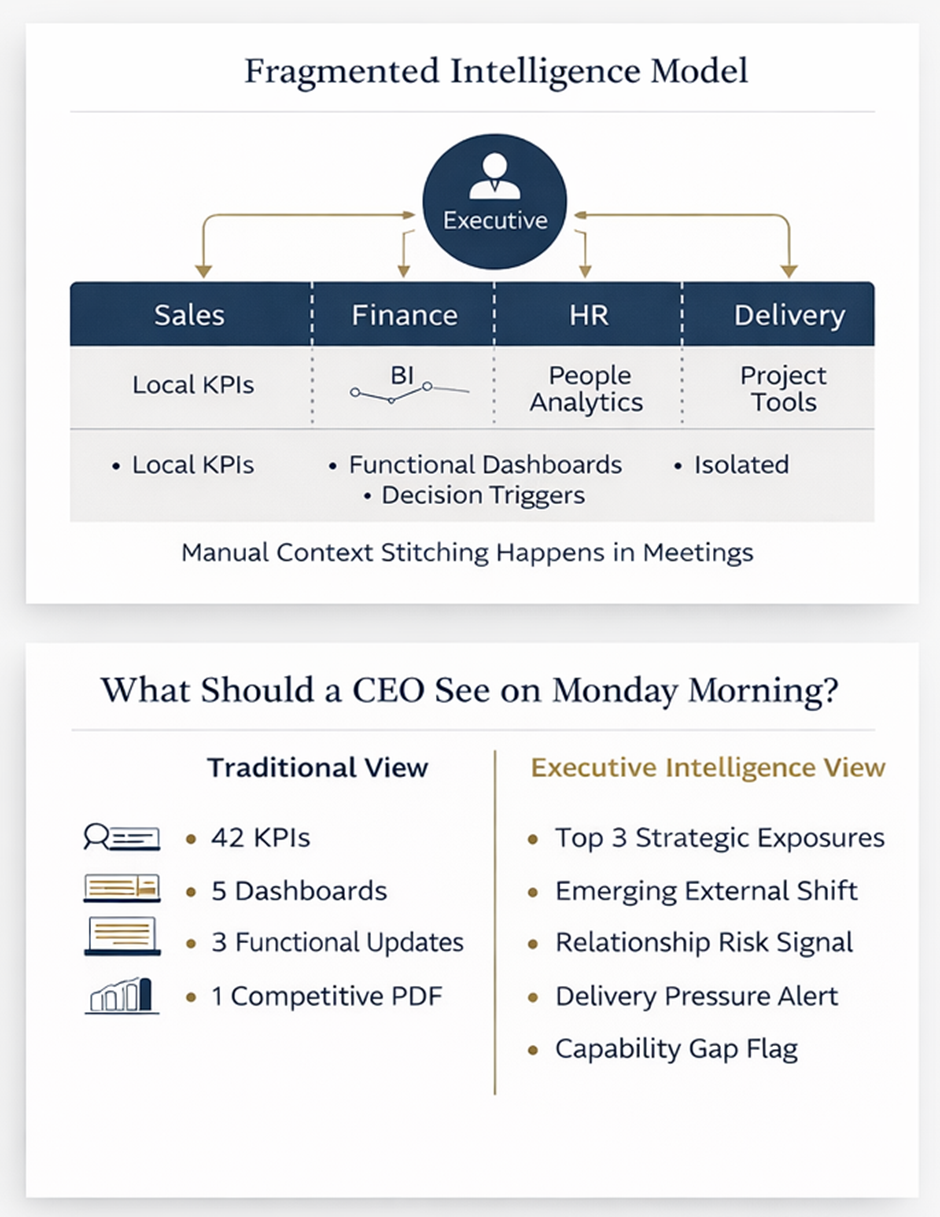
That stitching happened in meetings. Under time pressure. With partial context.
We realized the burden of synthesis had quietly shifted to the executive.
Dashboards Were Never Designed for Decision Gravity
Dashboards are excellent at answering descriptive questions. They tell you what happened. They show trends. They highlight anomalies.
But the hardest leadership decisions are not descriptive. They are directional.
They require judgment across silos. They require understanding second-order effects. They require prioritizing attention when everything looks important.
We kept asking a simple question internally: What should a CEO see on a Monday morning?
Not 40 KPIs. Not five unrelated dashboards. Not a PDF summary of competitor news. But a coherent view of:
- Where the organization is strategically exposed
- Which relationships require immediate attention
- What external signals alter internal priorities
- Where risks are compounding quietly
No system we encountered was designed to deliver that.
The Architecture Gap
Most enterprises have invested heavily in analytics infrastructure. But very few have invested in executive intelligence architecture.
The dominant design pattern is bottom-up. Data sources feed dashboards. Dashboards feed meetings. Meetings produce alignment.
But that model assumes executives have infinite cognitive bandwidth. It also assumes fragmentation can be solved with more visualization.
We saw the opposite. The more dashboards organizations added, the more reconciliation meetings multiplied. Intelligence became visible but not cohesive. AI layers began summarizing reports, but summaries of silos are still silos.
This was not a tooling deficiency. It was a structural flaw. Each system optimized for its function. No system optimized for executive cognition.
Designing NUDGE from the Decision Outward
When we began building NUDGE, we deliberately reversed the design logic.
Instead of asking, “How do we integrate more data?” we asked, “What decision context does an executive need before walking into a high-stakes conversation?”
That led us to define executive intelligence across four intersecting layers:
- Executive & Account Intelligence
- Competitive & Market Intelligence
- Delivery Intelligence
- Internal Health & Capability Signals
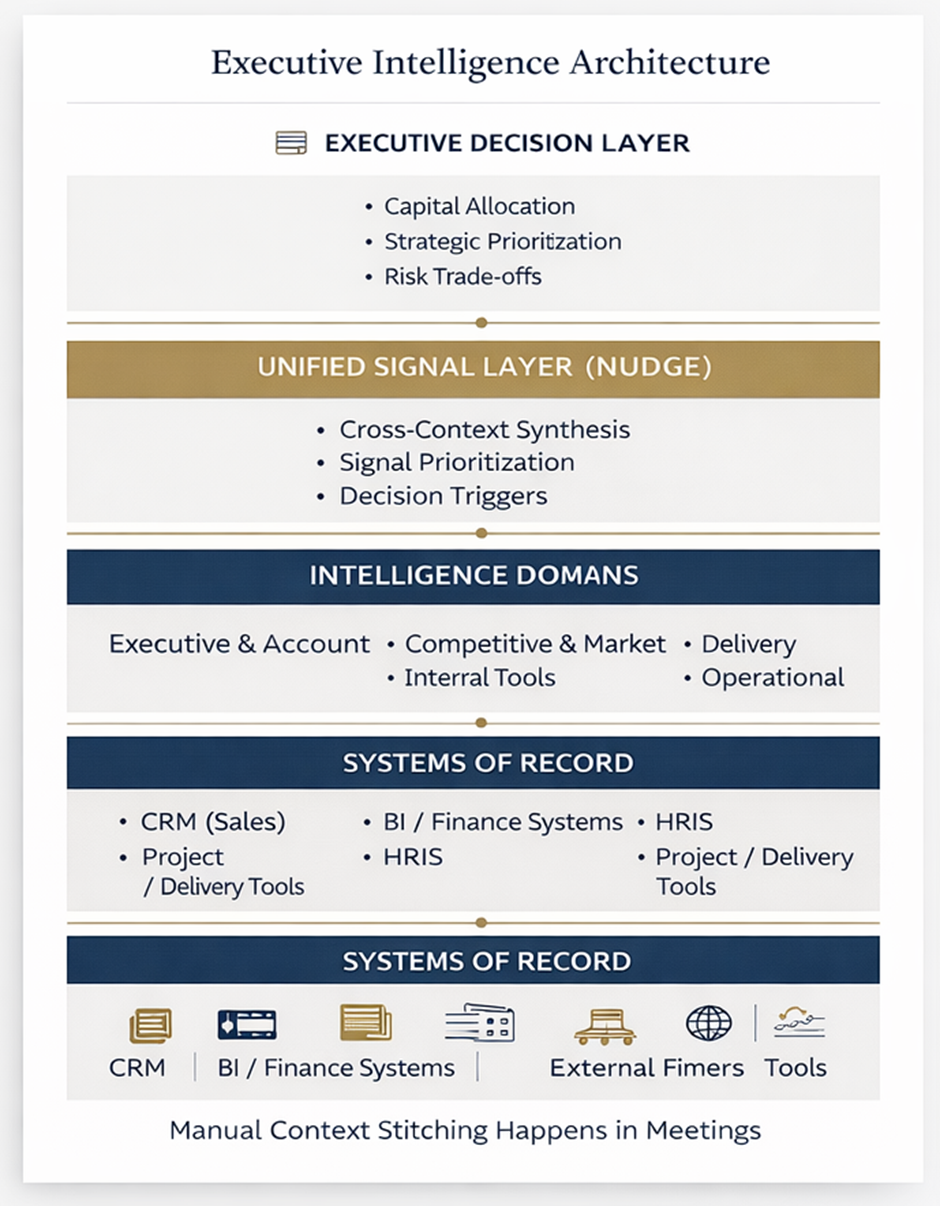
Individually, these layers exist in most organizations. The difference is that they operate independently.
NUDGE was built to connect them into a unified signal environment — what we call an intelligence fabric. The objective was not to replace CRM, BI, HR systems, or project tools. It was to sit above them and synthesize what they cannot.
If a competitor moves, the system should surface which executive relationships are exposed. If delivery strain increases, it should connect to account risk. If talent attrition rises in a niche capability, it should intersect with growth priorities.
Executives should not have to assemble this context manually. The system should do it before the meeting begins.
This Is Not About More AI
AI can summarize dashboards. It can detect anomalies. It can generate insights faster than any analyst.
But if the underlying architecture is fragmented, AI simply accelerates fragmentation.
The leverage is not in faster reporting. The leverage is in structured coherence.
NUDGE was built to reduce decision latency by unifying signal across silos and surfacing what matters relative to strategic priorities. It is less about visualization and more about orchestration.
Why This Matters Now
The complexity facing leadership teams is compounding. Competitive cycles are compressing. Regulatory shifts are unpredictable. Talent mobility is high. Capital markets are unforgiving.
In this environment, leadership attention becomes the ultimate scarce resource.
Not every metric deserves executive time. Not every fluctuation requires discussion. Not every dashboard deserves to be opened.
The organizations that move fastest will not be those with the most data. They will be those with the clearest signal architecture.
We built NUDGE because we were tired of seeing intelligent leaders forced to manually assemble coherence in rooms that should have been focused on decisions.
Executive intelligence should not be accidental. It should be architected. And that is exactly what we set out to build.
Want to explore how Alethic can bring intelligence architecture to your organization?